
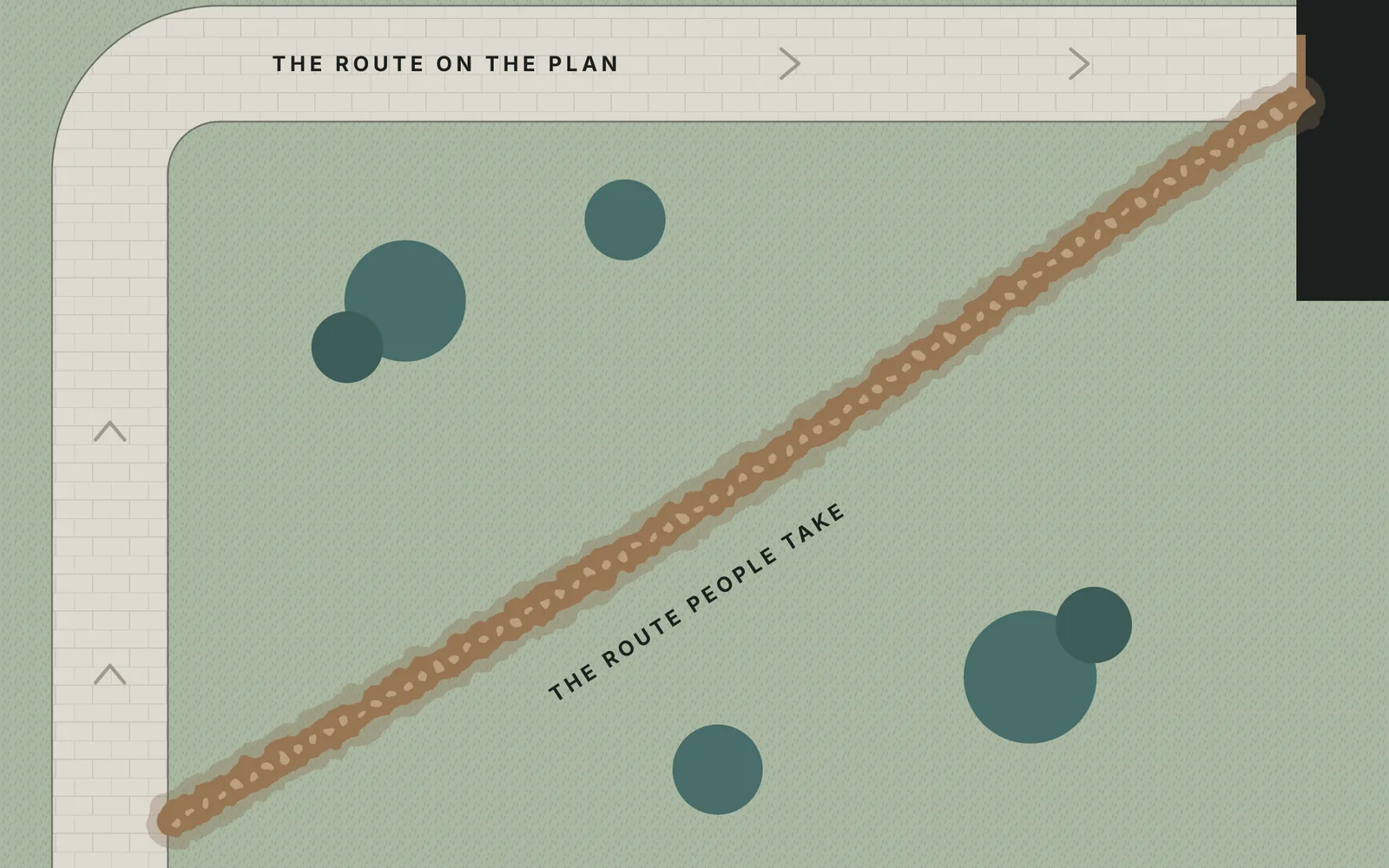
Formal authority says who should decide. Informal networks often decide who has the information, confidence and cooperation to act. How to see both maps, and why good structure depends less on knowing the right person.
An organisation chart has a reassuring quality. Lines connect people to managers, teams to functions, and functions to executives. It supplies a picture of order. If a decision stalls, we should know whom to ask. If a project fails, the chart should indicate who owns it.
That is what the chart is designed to describe: a formal allocation of roles and authority. It is not designed to show where people go for advice, whom they trust with uncertainty, who can resolve a cross-functional impasse, or which employee quietly translates between two teams that otherwise misunderstand each other.
Both structures exist in the same workplace. Trouble comes when leaders confuse one for the other.
An organisation has at least three maps
David Krackhardt and Jeffrey Hanson made a useful distinction in their 1993 work on informal organisational networks: the people one communicates with, trusts and asks for advice do not necessarily correspond to reporting lines.1 That does not make formal design pointless. It means the design captures only one kind of relationship.
Consider three questions. Who is formally accountable for approving a proposal? Whose opinion makes others comfortable enough to support it? Who knows what information was left out? The answers could be three different people.
The first question belongs to a chart of authority. The second belongs to a map of trust. The third belongs to a map of knowledge. A fourth map, of actual work, would show who moves the proposal from one stage to the next when the named process cannot accommodate reality.
Imagine an entirely hypothetical agency with a strategy team, a technical delivery team and an account-management team. The chart assigns a manager to each. Yet the person who prevents most missed deadlines is a project coordinator who knows when a design approval will delay a technical implementation and who can translate that risk into language all three groups understand. The coordinator may possess little formal power and considerable operational influence.
Whose view makes others comfortable?
Diagram: links run sideways between Designer and Developer, Developer and Coordinator, Coordinator and both the Account and Delivery leads, and Strategy lead and Director.
A different shape: reassurance travels sideways, through people who have worked together, not up the reporting lines.
Who knows what was left out?
Diagram: the Coordinator is linked to every other team member, and nobody else is linked.
Here the coordinator is the hub. If that person leaves, the chart above does not change. The work may change dramatically.
If that employee leaves, the chart appears unchanged. The work may change dramatically.
This is the kind of fragility an executive can miss by studying headcount and reporting layers alone.
The hidden work of translation
Organisations are divided to make complexity manageable. Specialisation creates expertise, but it also creates different vocabularies, incentives and clocks. Sales wants speed and confidence. Delivery wants reliable requirements. Finance wants commercial boundaries. Legal wants risk made explicit. None of these priorities is inherently defective. Each becomes a problem when it acts as if its own definition of success is complete.
Coordination often depends on people who can live between these definitions. They interpret an ambiguous commitment, warn a colleague before a deadline becomes public, or bring together two people who do not share a manager. Their contribution may not be captured as an individual deliverable. It appears in the form of failures that did not happen.
That makes it easy to undervalue. The employee who resolves a conflict before escalation produces no dramatic incident report. The one who spots a dependency while there is still time to act may look less productive than someone visibly extinguishing a fire.
An organisation can therefore reward spectacular recovery while overlooking quiet prevention.
Brokerage is valuable, and it can be dangerous
Network research uses concepts such as brokerage to describe positions that connect otherwise separated groups.2 In practice, the employee who connects groups can help information travel and make collaboration possible. But reliance on a single broker can also create bottlenecks.
A trusted individual may become the only route between departments, turning every significant question into a personal interruption. A leader may lean on informal favourites instead of designing accessible processes. Employees outside an influential circle may find that decisions appear settled before their perspectives are invited.
The informal organisation is not a hidden democracy of the wise. Trust networks can sustain exclusion. Personal relationships can move incorrect information efficiently. Influence is not the same as expertise, and a charismatic broker can be as capable of distorting a decision as of improving it.
A sensible response is therefore not to celebrate every informal connection. It is to understand what function the connection serves, whom it excludes, and why the formal structure cannot perform that function dependably.
Why a survey of names is not enough
Organisational network analysis can ask employees whom they approach for advice or with whom they collaborate. Such work can reveal surprising central figures and isolated groups. But the data do not arrive as neutral truth. The questions chosen determine which relationships become visible. Confidentiality matters because identifying a trusted confidant may disclose sensitive information about workplace relationships. A network snapshot also may miss how influence changes during a crisis or on a particular project.
Research reviews caution that organisational ties can include positive, negative, overlapping and dormant relationships; a simplistic chart of arrows will not fully explain behaviour.2 Managers should resist using network maps as a covert ranking of employees.
A more responsible approach begins with a work problem. Perhaps client handovers repeatedly create rework. Instead of asking who is popular, ask where information is lost, what context people need, and who currently repairs the gap. Map the process through observation and voluntary, privacy-conscious conversations. Test proposed changes with the people doing the work.
The goal is not to reveal a secret hierarchy. It is to remove dependence on secrecy.
Formal authority still matters
Some advocates of informal networks speak as if the chart is a bureaucratic relic. That is a mistake. A legal entity cannot make accountability optional. Someone must have authority to spend money, approve a release, sign a contract and take responsibility when a customer is harmed.
The issue is whether those decision rights are connected to the people and information that make sound decisions possible. A manager may hold approval authority yet be structurally far from the facts. An employee may understand a serious risk yet have no reliable path to surface it. The remedy is not necessarily a flatter chart. It may be a better escalation route, an explicit consultation requirement, a shared decision record or a redesigned handoff.
Good structure makes cooperation less dependent on knowing the right person.
A practical test of the real organisation
Take one critical decision that recently caused delay. Reconstruct its actual route rather than the route described in an SOP. Who discovered the issue? Who interpreted it? Who had the necessary information? Who was formally authorised to decide? Who quietly persuaded others? At which point did the decision become irreversible? Finally, ask which step would fail if one particular person took leave for a month.
That last question can reveal a hidden single point of failure. It also reveals where the company has been relying on personal goodwill instead of repeatable design.
An organisation chart is a promise about responsibility. The real organisation is the pattern of interactions through which that promise is kept, stretched or broken.
A mature leader should be able to look at both without pretending they are the same picture.
ABOUT THIS ESSAY
Published 20 November 2026.
Citations & references
- Krackhardt, D. & Hanson, J. R. (1993). Informal Networks: The Company Behind the Chart. Harvard Business Review, July–August 1993. https://hbr.org/1993/07/informal-networks-the-company-behind-the-chart
- Brass, D. J. (2022). New Developments in Social Network Analysis. Annual Review of Organizational Psychology and Organizational Behavior, 9, 225–246. https://www.annualreviews.org/content/journals/10.1146/annurev-orgpsych-012420-090628